 EN
EN

Decoding NEMA vs. IP Ratings for Global Distribution
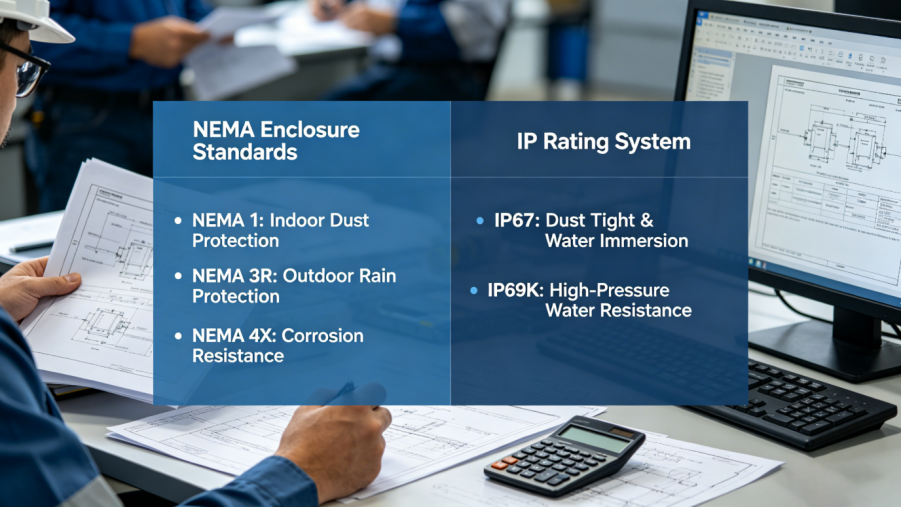
For B2B buyers and project engineers operating across international borders, the "Standards Gap" can be a significant source of confusion, project delay, and regulatory risk. While the European, Asian, and Oceanic markets rely almost exclusively on the IP (Ingress Protection) rating system defined by IEC 60529, the North American market (USA, Canada, Mexico) follows the NEMA (National Electrical Manufacturers Association) standards defined by NEMA 250. Understanding how these ratings overlap—and where they diverge—is critical for ensuring regulatory compliance, insurance validity, and site safety in global projects.
The Philosophical Difference: Ingress vs. Environment
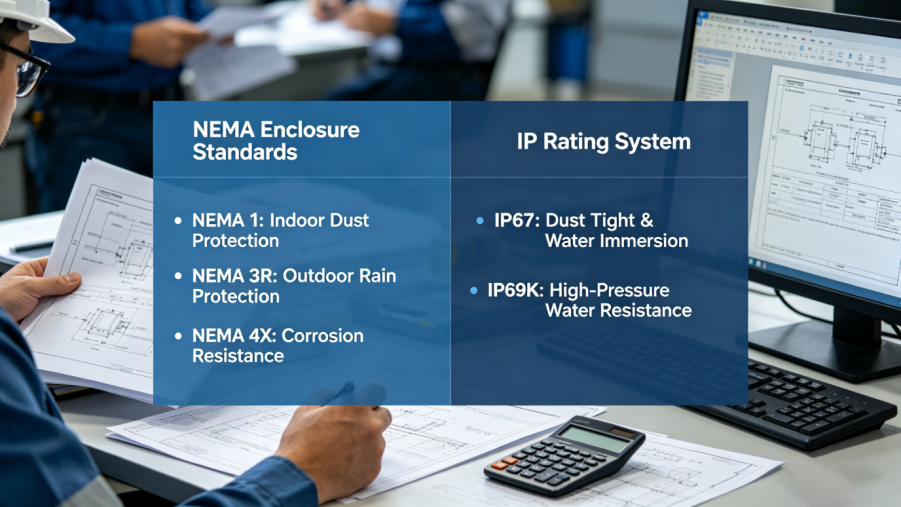
The most important thing to understand is that IP and NEMA ratings are not directly "convertible" because they test different criteria using different methodologies.
- IP Ratings focus strictly on protection against the ingress of solids (dust, tools, fingers) and liquids (water). It is a binary "ingress or no ingress" test. It does not account for the *long-term* effects of the environment on the enclosure itself.
- NEMA Ratings are more holistic. They include ingress protection similar to the IP system, but they *also* mandate specific tests for environmental factors. These include corrosion resistance (salt spray testing), gasket aging (accelerated weather testing), and resistance to external icing (ice-load testing).
Analyzing the Equivalencies for B2B Sourcing
While there is no official conversion table, the international engineering community follows these general equivalencies to bridge the gap between IEC and NEMA regions:
NEMA Type |
IP Equivalent |
Typical B2B Application |
NEMA 1 |
IP20 |
Basic indoor use; protects personnel against contact with live parts. |
NEMA 3R |
IP14 / IP24 |
Outdoor use; protects against rain, sleet, and external ice. Common for residential meters. |
NEMA 12 |
IP54 |
Industrial indoor use; protects against circulating dust, lint, and dripping non-corrosive liquids. |
NEMA 4 |
IP66 |
Watertight and dust-tight; protected against powerful water jets from any direction. |
NEMA 4X |
IP66 + Corrosion |
Same as NEMA 4, but with a mandated 200-hour salt spray test. This usually requires 304/316 Stainless Steel. |
NEMA 6P |
IP68 |
Submersible; protects against prolonged immersion in water at specific depths. |
The "4X" Factor: Why It’s the Gold Standard for Harsh Sites
In global B2B procurement, NEMA 4X is arguably the most requested rating for industrial sites. It represents an enclosure that is not only waterproof (IP66) but also corrosion-proof.
- Testing Rigor: To claim NEMA 4X, an enclosure must undergo a specialized salt spray test that simulates years of coastal exposure.
- Material Implication: You cannot achieve NEMA 4X with standard powder-coated carbon steel unless the coating is exceptionally thick and specialized. This is why high-grade stainless steel enclosures from B&J Electrical are the industry's go-to solution for 4X requirements.
- Strategic Sourcing Tip: If you are a buyer in a NEMA region (like the US) sourcing from an IEC region (like China), an IP66 stainless steel box with a TUV-verified material certification is a highly reliable and often cost-saving equivalent for NEMA 4X.
Why Independent Certification is Non-Negotiable
In the world of B2B electrical gear, "Self-Declaration" is a major risk. To satisfy insurers, building inspectors, and safety auditors, you must have documentation from an accredited lab.
- Third-Party Validation: B&J Electrical provides TUV and CE test reports that certify our enclosures to the IEC 60529 (IP) standard. We don't just put an IP66 sticker on the box; we provide the laboratory data to back it up.
- Material Verification: For stainless steel orders, we provide mill certificates that prove the nickel and chromium content meets the requirements for 304 or 316 grades, which is essential for satisfying the corrosion-resistance intent of NEMA 4X.
- Global Project Support: When our international clients use our IP66 boxes in North American projects, our technical team provides the cross-reference documentation needed to demonstrate to local AHJs (Authorities Having Jurisdiction) that the enclosure meets the required safety intent.
Conclusion: Bridging the Global Standards Gap
Choosing the right rating requires a deep understanding of the *actual* environmental stressors of your site. If your only concern is high-pressure water jets in a controlled factory, IP66 is your benchmark. If you face salt air on a coastal wind farm or ice buildup in a northern climate, you need the added environmental testing inherent in the NEMA (or equivalent B&J "Marine Grade") standards. By understanding these global benchmarks, B2B procurement teams can widen their supplier pool, reduce costs, and maintain absolute confidence in the safety of their electrical infrastructure.
Table of Contents
- Decoding NEMA vs. IP Ratings for Global Distribution
- The Philosophical Difference: Ingress vs. Environment
- Analyzing the Equivalencies for B2B Sourcing
- The "4X" Factor: Why It’s the Gold Standard for Harsh Sites
- Why Independent Certification is Non-Negotiable
- Conclusion: Bridging the Global Standards Gap