 EN
EN

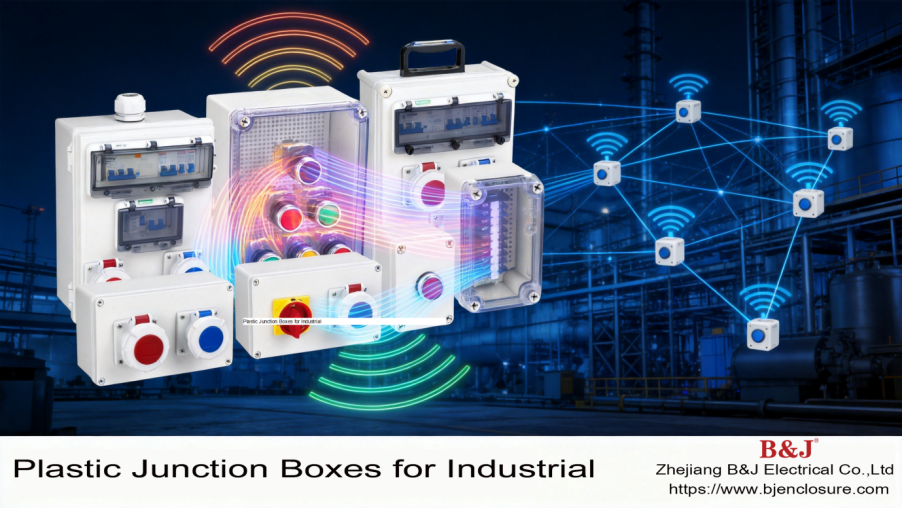
The Rise of Plastic Junction Boxes in Modern Automation: A B2B Perspective
In the rapidly evolving era of Industrial IoT (IIoT), smart manufacturing, and decentralized automation, the traditional reliance on heavy metal enclosures is being fundamentally challenged. While metal remains essential for high-voltage power distribution and heavy-duty structural cabinets, plastic junction boxes—specifically those engineered from advanced polymers like Polycarbonate (PC) and ABS—are becoming the preferred choice for signal management, wireless sensor housing, and lightweight control logic. For B2B organizations building the "Industry 4.0" systems of tomorrow, plastic offers unique technical and logistical advantages that metal simply cannot match.
1. RF Transparency: The Unfair Advantage in IoT
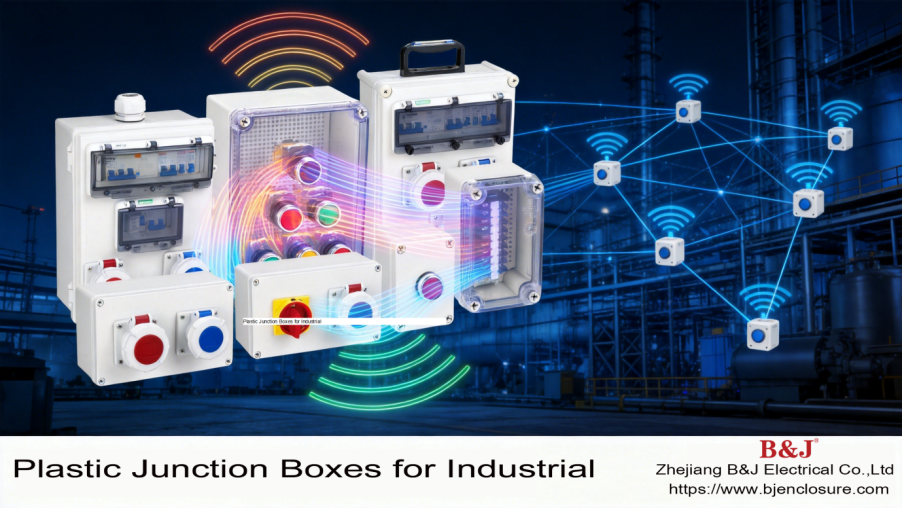
The most critical advantage of plastic in modern automation is its radio-frequency (RF) transparency.
- The Faraday Cage Problem: Metal enclosures act as Faraday cages, effectively blocking Wi-Fi, Bluetooth, Zigbee, LoRaWAN, and cellular signals. To use a wireless sensor or gateway inside a metal box, you must drill a hole and install an external antenna, which adds cost, labor, and creates a potential leak point for water and dust.
- Plug-and-Play IoT Deployment: Plastic enclosures allow internal antennas to function at full strength. This simplifies the deployment of mesh networks and remote monitoring sensors across a factory floor or an outdoor facility. At B&J Electrical, our high-transparency PC boxes allow for "Smart Boxes" that communicate wirelessly without any external modifications.
2. Superior Corrosion Immunity in Chemically Aggressive Sites
While stainless steel is corrosion-*resistant*, high-grade polymers are fundamentally corrosion-*immune*.
- Chemical Stability: Plastic boxes from B&J Electrical are tested against a wide array of industrial acids, alkalis, and oils. This makes them the superior choice for wastewater treatment plants, battery storage facilities, agricultural automation (where fertilizers are present), and coastal sensor arrays.
- Maintenance-Free Lifecycle: Unlike carbon steel, there is no powder coating to chip, scratch, or peel. The material is the same color and consistency throughout, ensuring it maintains its protective properties and aesthetic appeal for its entire 20-year service life without the need for touch-up painting.
3. Lightweight Logistics and Improved Personnel Safety
- Logistics Savings: Plastic enclosures can be 50-70% lighter than their metal counterparts. For a B2B distributor, this means lower shipping costs and easier handling in the warehouse. For the installer, it means a single person can mount a large junction box on a wall or a robotic arm without the need for a second set of hands or specialized lifting gear.
- Electrical Insulation (Safety by Design): Plastic is a natural dielectric (insulator). This provides an inherent layer of safety against "fault-to-enclosure" accidents. In the event of a loose wire touching the internal wall, the exterior of the box remains safe to touch, drastically reducing the risk of electric shock for maintenance personnel compared to a metal box that isn't perfectly grounded.
- Ease of Modification: Drilling or cutting plastic on-site is faster and cleaner than working with steel. It doesn't produce the conductive metal shards that can ruin sensitive circuit boards if not perfectly cleaned up.
4. Material Choice: Polycarbonate (PC) vs. ABS
Choosing the right polymer is as technically important as choosing the right steel grade.
- Polycarbonate (PC): Known as "The Engineer’s Plastic." It offers extreme impact resistance (IK08+), excellent UV stability for outdoor use, and a wide operating temperature range (-40°C to +120°C). B&J’s PC boxes are the standard for outdoor solar monitoring and public infrastructure.
- ABS: A more cost-effective polymer for indoor automation applications where UV exposure is not a concern. It is highly durable and offers great resistance to most industrial chemicals used in factory floor environments.
5. Achieving IP68 Protection with Plastic Engineering
A common myth in the B2B world is that plastic enclosures cannot achieve the same high-level seals as metal. At B&J Electrical, we dispel this through precision injection molding and advanced gasket technology.
- Poured-in-Place Silicone Gaskets: Our plastic junction boxes use high-performance silicone gaskets that are applied as a liquid and set in a continuous, seamless loop. This ensures a perfect seal even after hundreds of opening/closing cycles.
- Stainless Steel Fasteners: We use 304 or 316 stainless steel screws and hinges on our plastic boxes. This ensures that the closure mechanism—the most common failure point on "cheap" plastic boxes—never fails due to rust.
- Independent IP68 Certification: Our plastic boxes are independently tested to withstand prolonged immersion at specific depths, proving that "plastic" is a high-performance material capable of heavy-duty protection.
Conclusion: The "Hybrid" Future of Distribution
The modern industrial facility is moving toward a "hybrid" model: large floor-standing metal cabinets for the main power intake, and dozens of decentralized plastic junction boxes for the "nervous system" of the plant. B&J Electrical provides the full spectrum of these solutions, ensuring that your automation project is built on a foundation of RF transparency, chemical immunity, and cost-effective safety.
Table of Contents
- The Rise of Plastic Junction Boxes in Modern Automation: A B2B Perspective
- 1. RF Transparency: The Unfair Advantage in IoT
- 2. Superior Corrosion Immunity in Chemically Aggressive Sites
- 3. Lightweight Logistics and Improved Personnel Safety
- 4. Material Choice: Polycarbonate (PC) vs. ABS
- 5. Achieving IP68 Protection with Plastic Engineering
- Conclusion: The "Hybrid" Future of Distribution