 EN
EN

Selection Guide for IP66/IP67/IP68 Waterproof Enclosures: Ensuring Industrial Safety
In the demanding world of industrial electrical systems, protection against environmental factors is non-negotiable. Whether it’s heavy rain, dust storms, or high-pressure water jets, your equipment relies on the integrity of its enclosure. For B2B procurement managers and electrical engineers, understanding Ingress Protection (IP) ratings is the first step toward system reliability. However, simply "checking the box" on a rating isn't enough—you need to understand the physics of failure, the specific testing protocols that distinguish a reliable enclosure from a potential liability, and the long-term maintenance required to preserve that rating.
Decoding the IP Rating System: Beyond the Basics
The IP rating system, defined by the International Electrotechnical Commission (IEC) 60529 standard, uses two digits to quantify protection levels. While the first digit refers to protection against solid objects (0-6), it is the second digit—representing liquid protection (0-9)—that often determines the survival of outdoor power distribution systems.
IP66: The Workhorse of Outdoor Infrastructure
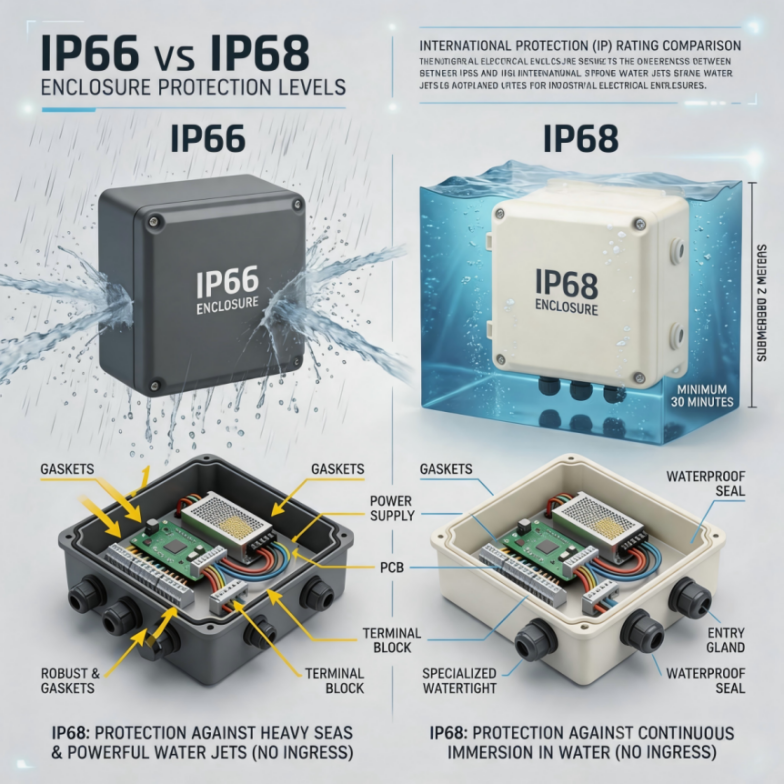
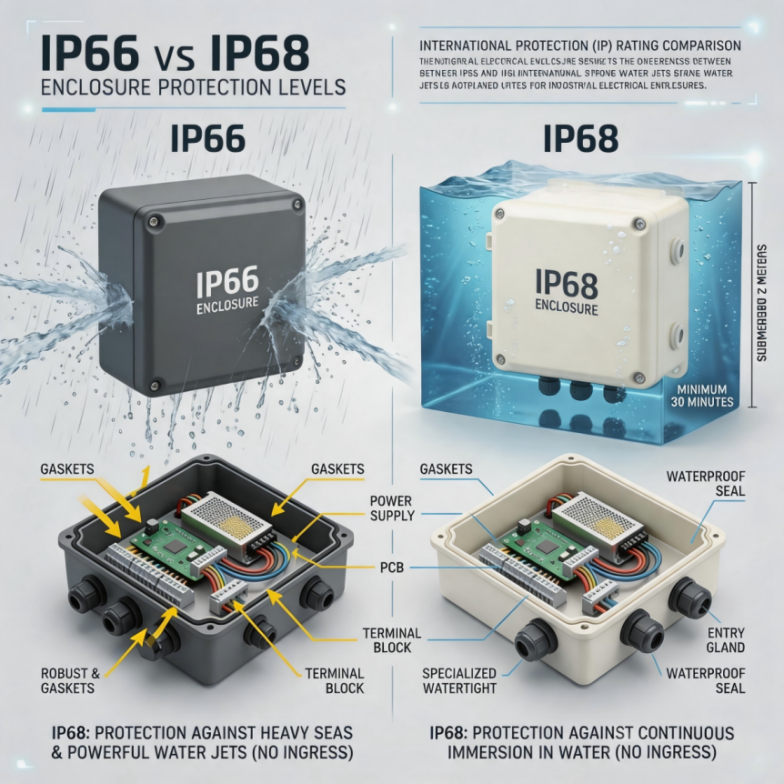
An IP66 rated enclosure is "dust tight" and protected against powerful jets of water. But what does "powerful jets" actually mean in a testing facility? To achieve IP66, the enclosure must withstand water sprayed from a 12.5mm nozzle at a flow rate of 100 liters per minute from any direction, at a pressure of 100 kPa from a distance of 3 meters.
In a real-world scenario, this equates to the deck of a cargo ship during a North Atlantic storm, or a food processing plant floor undergoing daily high-pressure washdowns with industrial detergents. For B2B buyers, IP66 is the baseline for most outdoor wall-mount enclosures. It ensures that internal components stay dry even when subjected to temporary, high-velocity water impact. However, it is important to note that IP66 does *not* imply the enclosure can handle submersion.
IP67: When Temporary Immersion is a Risk
Moving to IP67 provides protection against the effects of temporary immersion in water. Specifically, the enclosure must remain watertight when submerged at a depth of 1 meter for at least 30 minutes.
This rating is critical for sites prone to flash flooding, underground cable pits, or machinery that operates in proximity to large bodies of water. The engineering challenge for IP67 is not just the gasket quality, but the structural rigidity of the enclosure. Under 1 meter of water, the external pressure increases significantly. A weak enclosure wall can flex, breaking the seal at the corners. Furthermore, the management of internal air pressure during rapid temperature changes—such as a hot enclosure being suddenly hit by cold floodwater—can create a vacuum that pulls moisture through even the tightest seals.
IP68: The Gold Standard for Continuous Submersion
For applications requiring continuous immersion, IP68 is the requirement. Unlike IP67, the specific depth and duration for IP68 are agreed upon between the manufacturer and the user, but it is always more stringent than IP67. B&J Electrical’s IP68 junction boxes are tested for long-term submersion at depths often exceeding 3 meters. These are ideal for underwater sensors, marine installations, and deep-well power management. Achieving IP68 requires specialized poured-in-place silicone gaskets and often necessitates reinforced screw-down lids rather than traditional hinged doors to ensure uniform pressure across the seal.
The Hidden Complexity: Pressure Breathing and Condensation
A common cause of failure in high-IP enclosures is not "leakage" in the traditional sense, but "breathing." When an enclosure is powered, the internal components generate heat, causing the air to expand and increase pressure. When the power is turned off or rain hits the hot enclosure, it cools rapidly, creating a vacuum.
Without a high-quality seal or a specialized ventilation plug, this vacuum can suck moisture *through* the gasket or cable glands. This moisture then condenses inside the box as it cools, leading to corrosion, short circuits, and "ghost" faults that are difficult to diagnose. At B&J Electrical, our IP66+ boxes often incorporate pressure-equalizing vents (breather valves). These vents allow air to pass to equalize pressure but block liquid water and dust, effectively solving the condensation problem that plagues lower-quality generic boxes.
Material Choice: Durability Meets Protection
While the IP rating tells you *how* well it’s protected today, the material determines *how long* that protection will last under UV stress, chemical exposure, and physical impact.
- Metal (Stainless Steel 304/316): Offers superior mechanical strength, IK10 impact resistance, and is the only choice for highly corrosive environments like chemical plants, offshore oil rigs, or coastal sites. 316 stainless steel, with its molybdenum content, provides the highest level of protection against salt spray.
- Carbon Steel (Powder Coated): A robust and cost-effective solution for inland industrial use. The quality of the powder coating is paramount; B&J uses UV-stable outdoor polyester coatings to prevent the "chalking" and peeling that leads to rust.
- Plastic (Polycarbonate/ABS): Provide excellent chemical resistance and are non-conductive, making them safer for certain residential or light industrial applications. They are also RF-transparent, which is critical for housing wireless IoT gateways or smart meters.
Installation Best Practices for Preserving the IP Rating
A high-IP enclosure is an integrated system. If any part is compromised during installation, the entire rating is void. B2B procurement teams should ensure their installation crews follow these protocols:
- Cable Glands and Entries: Always use glands with an IP rating equal to or higher than the enclosure. Ensure they are torqued correctly; over-tightening can crush the gasket and cause a leak.
- Mounting Integrity: Avoid drilling through the back of the enclosure if possible. Use the external mounting brackets provided by the manufacturer. If you must drill, use specialized sealing washers and caps.
- Gasket Inspection: Before closing the door, ensure the gasket is clean and free of debris. A single grain of sand can compromise an IP67 seal.
- Orientation: For outdoor use, cable entries should always be at the bottom of the enclosure to prevent water from pooling around the entry points.
Why Choose B&J Electrical for Your Waterproof Solutions?
With 25 years of expertise and TUV/CE certification, B&J Electrical doesn't just sell boxes—we provide engineering peace of mind. Our enclosures are tested in-house and by third-party labs to ensure they exceed the requirements of IP66, IP67, and IP68. We understand the nuances of industrial environments, from the humidity of the tropics to the dust of the desert. From custom wall-mount metal enclosures to high-transparency plastic junction boxes, we provide the barrier your critical power systems demand.
Table of Contents
- Selection Guide for IP66/IP67/IP68 Waterproof Enclosures: Ensuring Industrial Safety
- Decoding the IP Rating System: Beyond the Basics
- The Hidden Complexity: Pressure Breathing and Condensation
- Material Choice: Durability Meets Protection
- Installation Best Practices for Preserving the IP Rating
- Why Choose B&J Electrical for Your Waterproof Solutions?